Sunday here is both a day of rest and a day of gathering. Normally worship is at 10:30 a.m., but on the first Sunday of the month, parents come to visit, and the day takes on a different weight. Today was that day.
Worship and Parent Visit Sunday
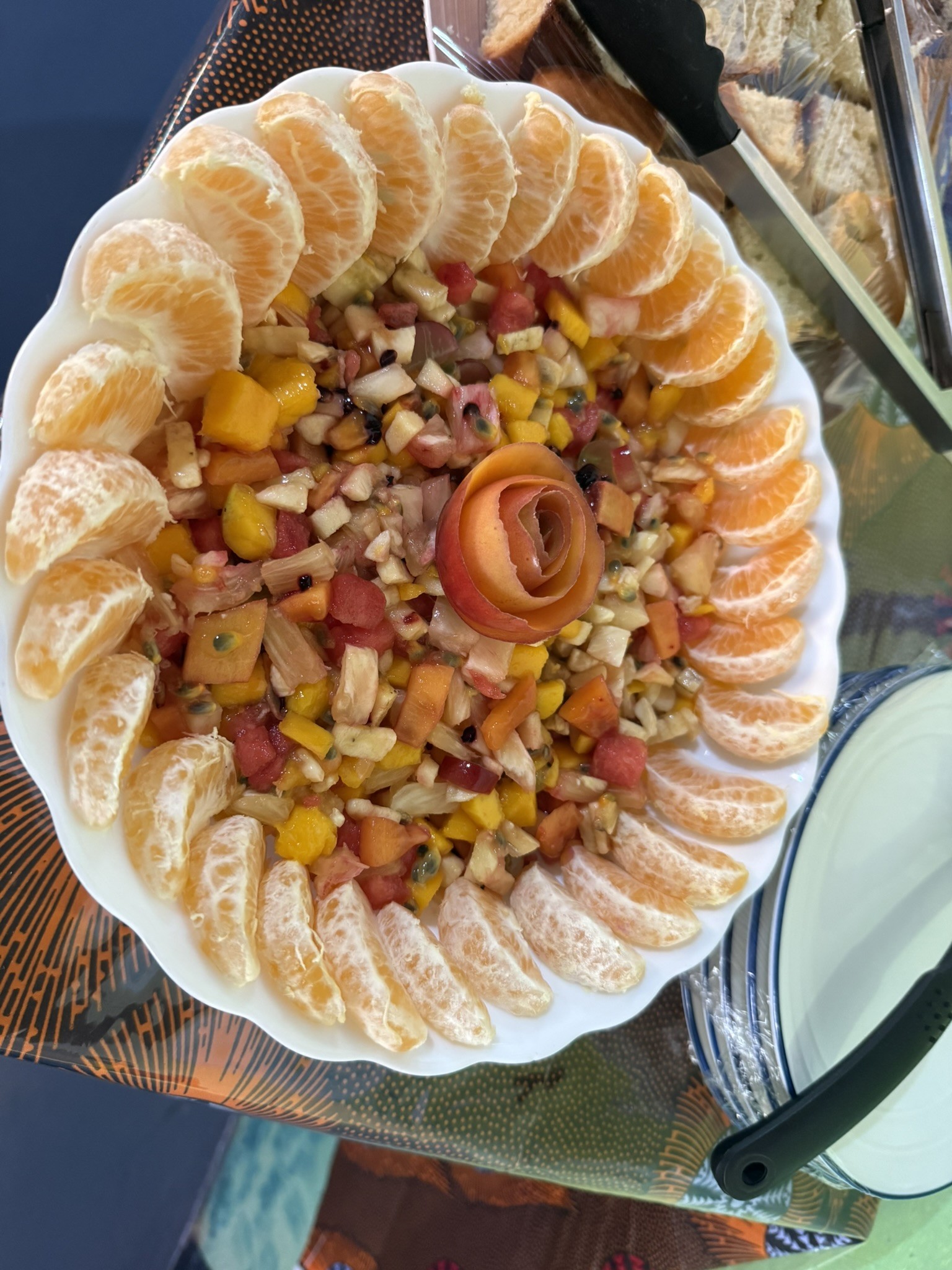
We ate breakfast at the usual time. John and his team once again served a meal that was both delicious and beautifully presented, every plate a small act of care.
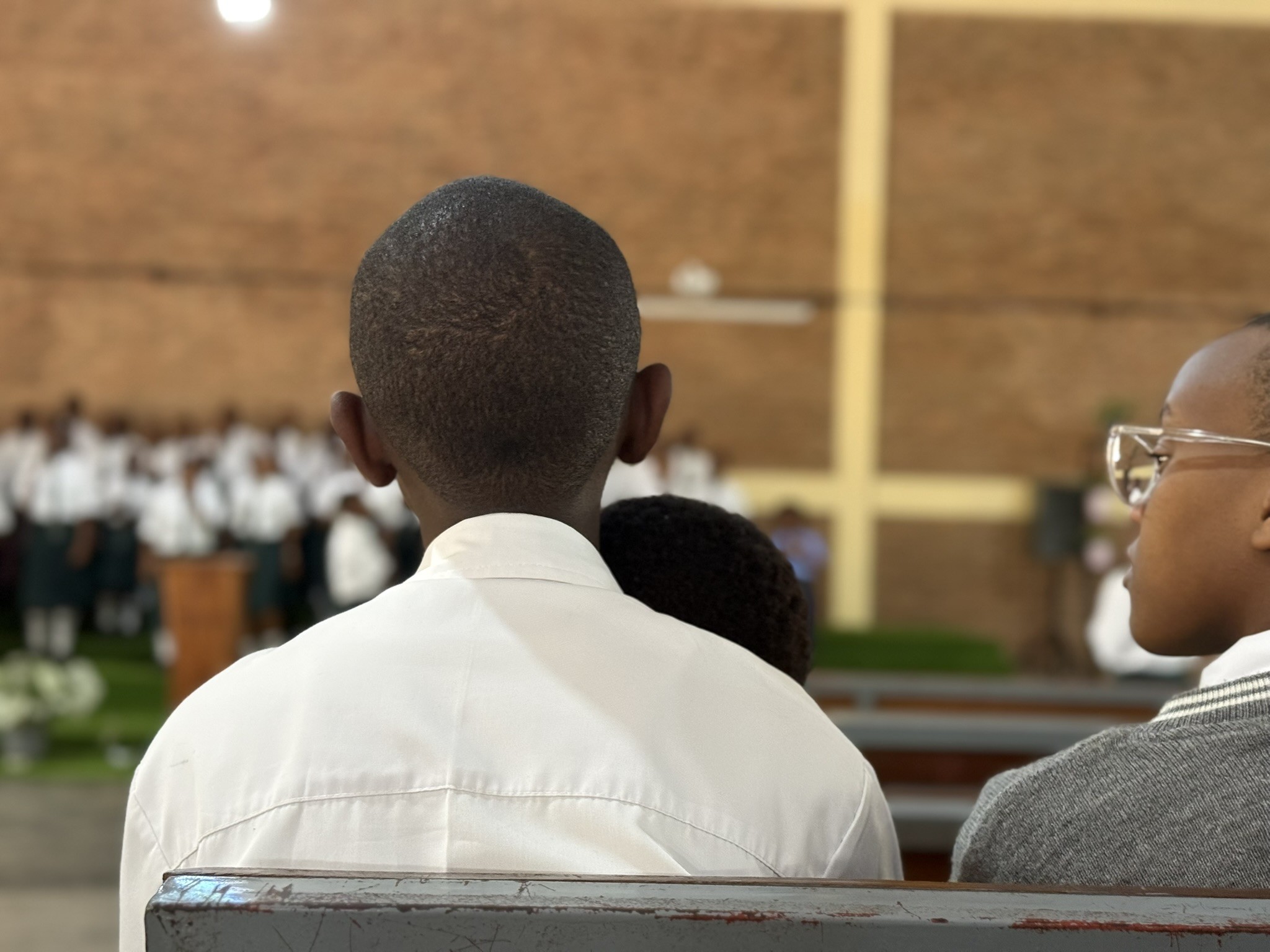
After breakfast, we walked to the fellowship hall for worship, which was student-led. As I watched them sing and dance, I thought, this is what it means to make a joyful noise unto the Lord. It was full of movement, joy, and volume — not polished performance, but honest praise.
As worship ended, the Headmistress stepped forward to address the families. She reminded them that Rwanda Children grades strictly and that every student’s marks are earned. Parents receive a report each time they visit. She asked them not to respond with anger if their child’s marks were lower than expected, but to encourage and support them. Then she spoke about integrity, sharing that the top student in one grade had recently been expelled for cheating. The student had already been given grace once before. It was a painful decision, but she made it clear that the school must expect honesty, even when it hurts.
I did not understand every word as it was translated, but I understood that.
She then asked me, Londyn, and Naomi to stand individually and greet everyone. Unsure what to do, I rose, turned to each side, lifted my hands, and said, “Welcome. I am so honored to be with you today.” Londyn and Naomi followed. I have decided that earplugs might be a wise addition to my worship bag — a joyful noise here is a loud noise.
Families Reunited
When the students were released to find their parents, the room dissolved into embraces and conversations. Some ran into arms already stretched open. Others scanned the crowd. I noticed the students whose families had not come. There are many reasons — distance, cost, obligations — and the students handled it with such courage, but the absence was still visible.
For about thirty minutes I watched parents and students reconnect: hugs that lingered, siblings squeezing each other tight, families looking over report papers together. After a while, I headed back to my room to catch up on a few tasks and rest. My “magic” sleep-music playlist did its work, and an alarm pulled me back up in time for lunch. Lunch was so good I went back for seconds.
After lunch, I returned to my room to rest again. I was very tired and had a special time scheduled with 9th and 10th grader girls from 3:00 to 5:00 p.m., followed by Conversation Corner. I set my alarm for 2:40 p.m., put on my shoes when it rang, and walked to the secondary school.
A Circle of Students and a Handful of Stories
I had been told we would meet in a classroom. Instead, when I arrived, there was a speaker set up in the covered outdoor gathering space — and the entire 9th and 10th grade classes were there, not just the girls. So I pivoted.
Earlier in the day, Londyn had shared that some students told her their generation is less forgiving than the generation who lived through the genocide. I don’t believe in broad generalizations, but their comment pointed toward historical trauma. So I sat down in a chair in the large circle of students and began there.
I introduced myself and explained the work I’ve been doing with staff and teachers. We talked about trauma — what it is, what kinds of events often lead to it, how the nervous system responds with fight, flight, freeze, or fawn. We talked about what it means to engage someone whose body is in survival mode. For about forty-five minutes, I did most of the talking.
Then I opened the floor for questions.
It is an unusual feeling to sit in a large circle with conversation buzzing in another language, but no one asking a question aloud. I had the sense that there were questions in the room; they just were not going to be voiced in front of so many peers. So I thanked them, asked a few questions back to check understanding, and told them I would be around if anyone wanted to talk. Then I released them back to their activities. It is never easy to be the reason a group of teenagers is called away from free time, and I was mindful of that.
Some questions will never be asked in a circle of eighty students, but given a little time and a smaller space, they come pouring out like water that’s been waiting behind a closed gate.
At first it looked as though everyone would simply walk away. Then one young woman approached me with a question. Then another. And another. Before long, about twelve students were sitting around me, asking deep, thoughtful questions: about abuse, about how child protection works in the States, about addiction and trauma, about how you walk alongside someone who is struggling. They had not been ready to ask these questions in the big group, but in a small circle of peers who were all truly interested, they were open and honest. They asked to see pictures of my family. We talked as long as we could before it was time for Conversation Corner.
Conversation Corner and Evening Kindness
I walked to the usual location and waited, thinking no one was coming. One of the young girls came to get me saying the students were waiting back where we had just been. Tonight’s group was twelve 8th graders.
We started with a brief introduction to the history and rules of Girl Guides, and then they asked me to introduce myself. I shared a bit about who I am and answered their questions. When no one had any more questions, they discussed what to do with the rest of the time. The overwhelming choice was singing.
We began the way I’ve started every group: with introductions of each other, not themselves. I modeled it first, asking them to share their partner’s name, one interest, and one personality trait. After each introduction, I said, “Welcome, [name],” and everyone clapped. It was simple, but it communicated something important: you are seen here.
I told them that tonight I mostly wanted to get to know them and that tomorrow we would focus on a principle and play a game. We talked about the parent visit. Every student in this group had family come. They spoke about how much they loved seeing them, and a few admitted they were nervous about sharing their marks. We talked about why some schools grade more strictly and how that can push students to learn. I shared how I came from a school that pushed us hard and later saw the difference when I studied alongside students who had not had that experience. They nodded; they understood.
Then I asked if they would be comfortable sharing how many siblings they have. Two, three, four, six — and one young man with eight siblings. We laughed together. As we closed, one of the students prayed over our time, and then we dismissed.
As the girls walked back to their dorms, several of them were signing in ASL. It was a small thing, but it felt like one more thread of connection woven into the day.
On my walk back to the guesthouse, I heard laughter from the volleyball court. I looked over and saw Londyn and Naomi playing Uno with Immanuel, one of the staff. I joined them for a game. We played, teased, and laughed until the light began to fade.
When I returned to my room, I noticed again the small, consistent kindnesses here. The shoes I had worn on yesterday’s dusty walk were on the rack, spotless — red dirt gone, soles bright white. Everywhere I go, I’m called “Doctor,” not as an adjective, but as my name. Sometimes “Doctor Laurie.” The honor culture in Rwanda is something to learn from and, where we can, to model. You see it in smiles and kindness. You see it in twelve students who could spend a Sunday afternoon playing, yet choose instead to ask hard questions and learn. You see it in the way John and his team serve in the guest house.
The honor culture here is something to be learned and modeled.
Tonight we ate dinner and then sat talking for a while. I shared some of my own struggles; Londyn and Naomi listened and asked questions. Londyn shared dreams for her future. I’m excited to see what she will carry forward from this place.
Now, I’m back on the patio, finishing these notes, aware again of how blessed I am — to be in a country I love so much, and to be reminded that the work waiting back home is also work I deeply love.